New Zealand Rustic: Creating a home inspired by nature
By Kate Coughlan, Tessa Chrisp and Yolanta Woldendorp
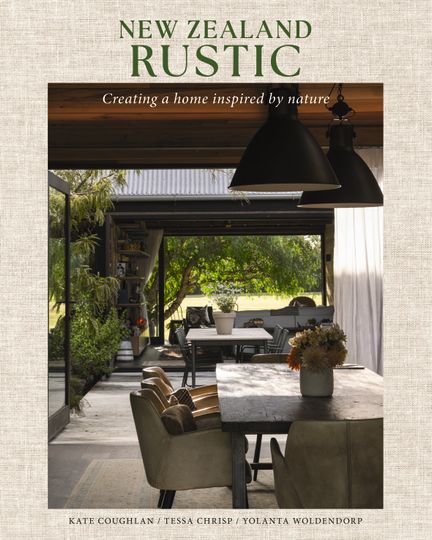
There is something faintly ridiculous about reading a book on cosy New Zealand farmhouses while sitting in Bali with a fan pointed at your ankles. Sheepskins. Hearths. Mohair rugs over a window seat. Whole pages devoted to the pleasure of a fire. I got about four spreads in before I started sweating on principle.
And yet I couldn't put it down, which tells you something about the book, and possibly something about me.
I've had a long, slightly envious thing for New Zealand houses. Australians and New Zealanders share a lot — the same weatherboards, the same corrugated iron, the same colonial habit of dropping a European house shape onto a landscape that never asked for it. But New Zealand seems to have made peace with its landscape faster than we have. Their houses tend to sit in landscape rather than on top of it. And of course, their Bachs ?. I've never fully worked out whether it's the scale of the terrain, the weather, or just a smaller design culture where everyone knows everyone and bad work gets noticed. Whatever the reason, I keep buying their books.

And this one is a beauty. Physically, first: it's a casebound hardback in a matte, uncoated-feeling stock that eats the light instead of bouncing it back at you. If you've ever flipped through a glossy interiors book under a downlight and had to tilt it forty-five degrees to see the photo, you'll understand why this matters. Matte paper makes the photography feel like a room rather than an advertisement. Art director Yolanta Woldendorp gets a credit on the cover, which is rare and, in this case, earned.
The structure is simple. A short front section on lighting, textures, colour, styling, and natural light and air, then six houses given proper room to breathe — thirty to fifty pages each. Waiau Homestead. Raggedy Ridge House. Te Au Homestead. Rumble Bay House. Ginkgo Point House. Manukard Gard.
The essays up front are the softest part of the book, and I say that as someone who agrees with nearly all of them. The lighting chapter is genuinely useful — layer your ambient, task and accent lighting, dimmers everywhere, warm-white globes, don't try to run a whole room off one ceiling fitting. That's advice I give clients most weeks. The colour and texture chapters are more atmosphere than instruction. Which is fine. That's not really what you buy this book for.

What you buy it for is the houses, and the reason the houses work is that each one is told as a story rather than presented as a result.
The best of them is Waiau Homestead. A 1911 villa on an East Coast sheep and cattle station, abandoned when forestry took over from stock, windows smashed by wandering goats. A local farmer takes a date out to see 'something interesting'. She's mad about old timber. They buy the thing. Life gets in the way for years. Eventually the house is cut into three pieces, trucked to a site above Gisborne's Wainui Beach, and reassembled — face to the sun, back turned to the wind. They strip the interiors expecting sarking and find rimu tongue and groove instead. The book says they couldn't have been happier if they'd found gold coins.
That's a renovation story with a decade of failure baked into it, and it's told without a hint of shame. I loved it.
Publisher Malcolm Rough — a farmer, and the owner of one of the six houses — makes the argument plainly in his introduction: a rustic home isn't designed on a drawing pad and it doesn't arrive on a delivery truck. "It evolves, it ages, it gathers richness with time." Which is, of course, the hardest thing in the world to sell to someone who has just handed you a budget and a completion date.

If I have a criticism, it's that this is a book about homes, not a book about architecture. There are no plans, no sections, very little on how these buildings actually perform through a Central Otago winter. Several are clearly the work of good architects, and you'd struggle to find out who from the pages. For a general reader that won't matter at all. If you're the sort who flips to the floor plan first — and I am — you'll finish it wanting a second, more technical book that doesn't exist.
The other risk is the word itself. 'Rustic' is doing a lot of work these days, most of it on Pinterest, and there are moments where the styling tips edge toward a look you could buy rather than a life you'd accumulate. The houses always pull it back.
I closed it wanting to go and find some old redwood, which is the only review that really counts.
For Australian readers, the translation is direct enough: the climates rhyme, the building stock rhymes, and the underlying idea — that a house should take its cues from the paddock, the coast or the ridge outside the door — travels perfectly well across the Tasman. Buy it for the Waiau story alone, but the whole book is a beautiful feast for the eyes.
Photography by Tessa Chrisp.
New Zealand Rustic: Creating a Home Inspired by Nature by Kate Coughlan, Tessa Chrisp and Yolanta Woldendorp. Published by Rough & Co, distributed in Australia by Peribo. Casebound hardback, 264 pages, printed on FSC-certified stock. RRP $60. ISBN 9780473743833.